This article examines how Low Emission Zones (LEZs) can contribute to a new urban mobility ecosystem, resulting in cleaner air, healthier streets, and greater equity when aligned with transformations in transport, logistics, and public space.
Why Distinguishing Policy Tools Matters
Across most cities, road transport is still one of the main sources of fine particulate matter, a pollutant strongly associated with higher mortality and a growing list of health concerns, including respiratory illness, cancer, and even neurodegenerative conditions like Alzheimer’s. LEZs and Congestion Charges are policy tools that have emerged to reshape how vehicles access dense areas, reducing the negative externalities of car use and influencing how people and goods move through the city. Yet despite their apparent similarity, they respond to different problems and operate through different mechanisms.
-
- LEZs regulate vehicle emissions, not traffic volume. Access is determined by the environmental performance of the vehicle, its age, fuel type, or emission standard. A low-emission vehicle can enter at any time; a high-emission one may be restricted even when the streets are empty. In this sense, LEZs function as a public health intervention, targeting the vehicles that contribute most to poor air quality.
-
- Congestion Charges regulate the number of vehicles entering a specific area, typically during peak hours. They are designed to reduce traffic volumes, free up road space, and improve travel times.
What Low-Emission Zones Are and What They Aim to Solve
Cities establish minimum emission standards, typically based on fuel type and vehicle age, and restrict or discourage the entry of the most polluting vehicles. The goal is straightforward: improve air quality and protect public health by reducing exposure to harmful pollutants such as NO₂, PM₂.₅, and black carbon.
Depending on local priorities and capacity, LEZs can take different forms:
-
- Standard LEZs, which restrict high-emission vehicles from entering a defined area.
-
- Another type is the Ultra-Low Emission Zones (ULEZ), which apply stricter standards and often cover larger territories.
-
- Typically found in dense commercial districts, Zero-Emission Zones (ZEZ) allow only electric or zero-emission vehicles.
Despite these variations, the underlying logic is consistent: cleaner vehicles first, especially in areas where pollution harms the most vulnerable.
Evidence and Impacts
When designed and enforced effectively, LEZs deliver measurable improvements in air quality, public health, and mobility patterns, with the greatest benefits often concentrated in communities that have historically borne the highest pollution burdens.
-
- Cleaner Air Where It Matters Most
One of the most immediate and well-documented effects is a significant decrease in harmful pollutants. Typically, cities that have implemented LEZs experience a significant drop in the number of polluting vehicles entering the area, resulting in improved air quality both within the zone and in neighboring communities.
- Cleaner Air Where It Matters Most
-
- Public Health Benefits, often for the Most Exposed
The introduction of LEZs has been shown to decrease asthma symptoms, reduce respiratory hospital admissions, and lower cardiovascular risks in multiple cities. The greatest improvements from LEZs are typically seen in low-income neighborhoods near high-traffic corridors, which were previously the most polluted.
- Public Health Benefits, often for the Most Exposed
-
- Shifts in Mobility and Vehicle Fleets
To accelerate the adoption of cleaner technologies, we can set minimum emission standards and promote the replacement of older, more polluting vehicles with newer ones. The implementation of Low Emission Zones in many cities has led to a gradual increase in cleaner delivery fleets, a surge in public transport usage, a growth in cycling and walking, and adjustments to logistics routes and schedules.
- Shifts in Mobility and Vehicle Fleets
-
- Economic and Productivity Gains
Cities with Low Emission Zones have found that cleaner air and more predictable traffic conditions can have a positive impact on local economies, despite concerns about economic impacts being a common topic in political debates. By reducing pollution, healthcare costs and absenteeism decrease, and commercial activity in retail districts can increase due to calmer, more walkable streets.
- Economic and Productivity Gains
By establishing clear expectations for cleaner mobility, they generate momentum for investing in public transport, cycling infrastructure, pedestrian improvements, and urban logistics reforms.
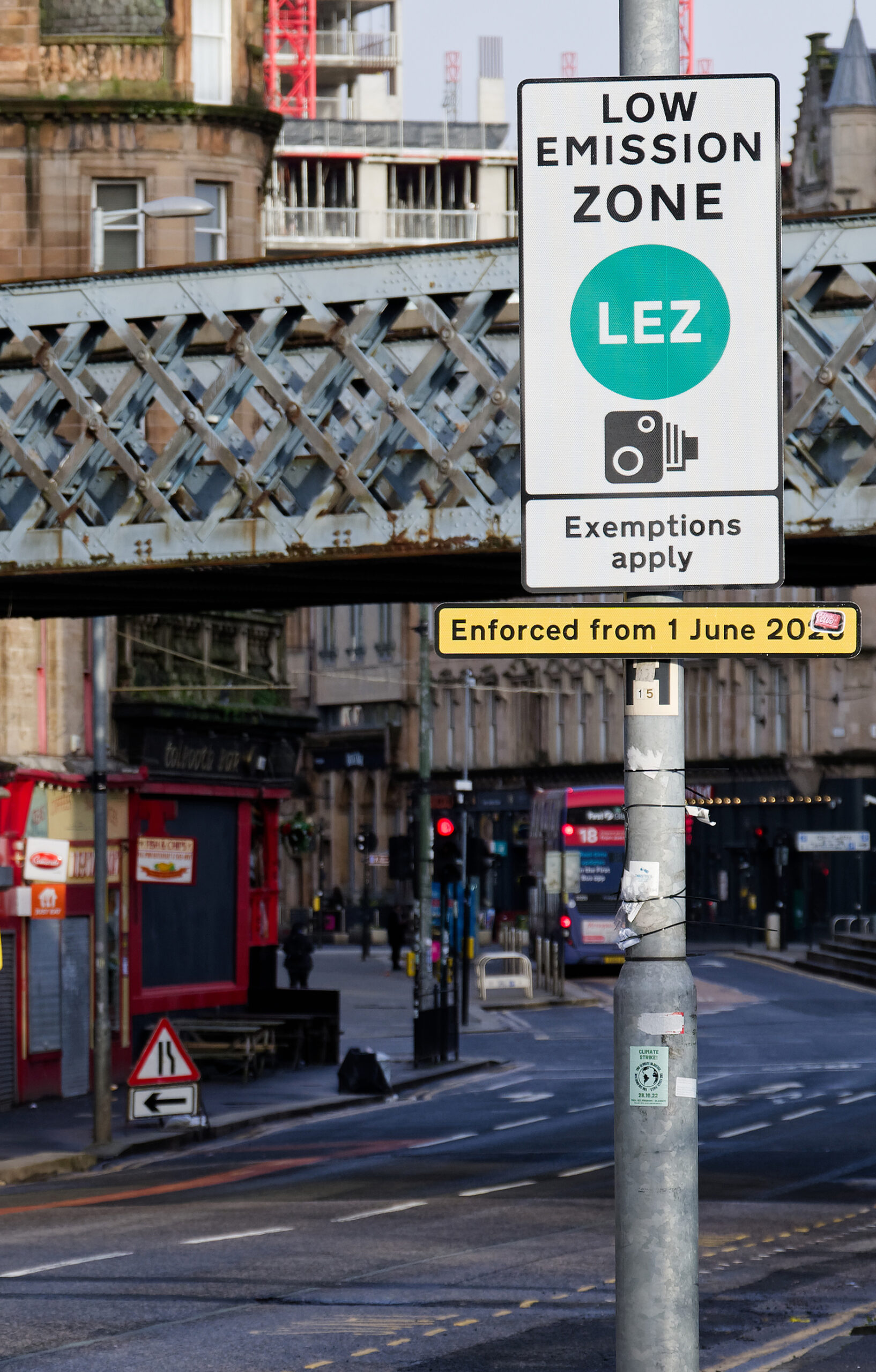
Low emission zone sign in city center of Glasgow being enforced for all vehicles. (Illustration: Adobe Stock)
Designing Effective and Equitable LEZs
The effectiveness of a Low-Emission Zone relies on not just what it regulates, but also on its design, communication, and support. While LEZs are powerful tools, they are not simple, plug-and-play solutions. Clear governance, predictable standards, and a grasp of community behaviors in public spaces are essential to their success. By aligning these elements, Low Emission Zones can effectively improve air quality and strengthen public trust.
-
- Technical Design Choices
Every LEZ starts with a set of design decisions that define its reach and effectiveness, including the geographic boundaries, vehicle categories and standards, gradual implementation to help residents and businesses adapt, and enforcement methods such as automatic number plate recognition (ANPR), radio frequency identification (RFID) systems, or manual checks. These technical decisions shape public perception and determine whether the policy feels fair, predictable, and transparent.
- Technical Design Choices
-
- Governance and Institutional Coordination
The intersection of transport, environment, public health, and urban planning is where LEZs are situated. To implement effectively, coordination is necessary across various agencies, including environmental regulators, transit authorities, and municipal police. A credible and adaptable policy over time is ensured by the presence of clear legal frameworks, stable funding, and robust monitoring systems. Successful cities implement LEZs as a key component of their long-term mobility strategy, rather than a one-off solution.
- Governance and Institutional Coordination
-
- Communication, Legitimacy, and Public Trust
Critical to success is public acceptance. It is essential for residents to comprehend the purpose, benefits, and support options available to them. Cities that prioritize transparent communication and engage with communities and businesses early on tend to be more effective.
- Communication, Legitimacy, and Public Trust
-
- Complementary Investments that Strengthen Impact
To maximize their effectiveness, LEZs should be combined with initiatives that promote alternative transportation methods and reduce dependence on high-emission vehicles, including enhanced public transport, pedestrian-friendly and cyclist-safe networks, EV charging infrastructure, and support for small businesses and low-income households. Especially in public transport electrification serves as a potent complement to Low Emission Zones. In dense areas, emissions can be significantly lowered with the use of electric buses, e-bikes, cargo bikes, and last-mile delivery vehicles.
- Complementary Investments that Strengthen Impact
In LEZ design, equity is not an afterthought, but rather the core consideration that decides whether these policies foster public trust or perpetuate existing inequalities. The effectiveness of a Low Emission Zone in closing or widening these gaps depends on its structure, communication, and support.
Transparent and accessible data not only builds trust but also enables cities to adapt their policies over time. Residents can track the real-time effects of cleaner air policies and hold governments accountable for ongoing improvement through air quality sensors, mobility dashboards, and community-led monitoring initiatives.
Case Studies
Worldwide, cities are testing various methods to curb pollution caused by traffic. Despite varying contexts, each provides valuable insights into adapting LEZs and related tools to local realities. These examples showcase a range of strategies, spanning mature regulatory systems to emerging mobility transitions, and offer valuable lessons for cities worldwide.
As a global reference point, London is often cited for its combination of multiple tools, including a long-standing LEZ, ULEZ, and congestion charge. The layered approach has resulted in significant decreases in NO₂ and PM₂.₅, expedited fleet renewal, and enhanced air quality in the city’s most polluted areas.
Scotland’s first Low Emission Zone was introduced in Glasgow, prioritizing the health of residents in the densely populated, pedestrian-friendly city center. Residents and businesses were given time to adapt as the policy was introduced gradually.
Unlike traditional Low Emission Zones, Singapore boasts a highly advanced congestion management system through its Electronic Road Pricing (ERP) system. Due to its strict vehicle ownership controls and high-quality public transport network, Singapore has achieved low congestion and relatively clean air, a remarkable feat considering its high population density.
The congestion charge in Stockholm was implemented after a trial period and a referendum, a unique instance of direct democratic endorsement for a policy of this kind. The charge, aimed at reducing traffic volumes, has also led to notable improvements in air quality and a decrease in emissions in the city center.
Bogotá‘s approach involves a combination of Pico y Placa, a policy restricting travel based on license plate numbers during rush hour, investments in electrifying Bus Rapid Transit, and targeted interventions to improve air quality in sensitive areas. Although not a traditional Low Emission Zone, the city’s policies prioritize reducing emissions from older vehicles and encouraging its population, which is heavily dependent on public transport, to adopt cleaner mobility options. The city has introduced a pioneering app-based dynamic congestion pricing system, designed to tackle mobility issues by decreasing traffic and encouraging eco-friendly options.
Lessons Learned
These cities collectively demonstrate that there is no one-size-fits-all solution to reducing traffic-related pollution. As ambitious mobility and air-quality agendas come together, a few powerful lessons have emerged.
-
- Effective initiatives combine strong political commitment with thorough, data-informed planning, guaranteeing that individual measures are integrated into a comprehensive strategy rather than standalone actions.
-
- By focusing on health, safety, and shared benefits, they frame changes in a positive light through early public communication and community engagement, rather than emphasizing restrictions. Rapid improvements in air quality and quality of life can be achieved by reallocating street space to prioritize public transport, walking, and cycling, if reliable alternatives to private car use are provided.
-
- Cities that successfully track impacts, adjust policies, and collaborate across agencies can move faster and build more durable public trust, which highlights the importance of institutional coordination and consistent monitoring.
The shift towards cleaner mobility goes beyond just emissions standards and enforcement technologies. Cities can be reimagined as safe havens where the air is clean, streets foster movement and connection, and the advantages of urban living are distributed more equitably. One key milestone on the path to a healthier, more livable city for all residents is the implementation of LEZs, a tangible commitment to this ideal.