This article explores the urban health gradient through the lens of proximity and equity in Santiago, Chile. By examining disparities between central and peripheral communes, it highlights how time and distance act as invisible determinants of health and longevity. Drawing on research, case studies, and policy perspectives, the article argues that livability must be redefined as a public health imperative, where proximity, equity, and resilience shape the future of metropolitan development.
It is a Disturbing Fact that the Location We Inhabit Can Determine Our Lifespan.
The urban health gradient is rooted in the reality that city design, infrastructure, and governance create invisible boundaries, which ultimately affect life expectancy, resulting in years either gained or lost. The contrast in Santiago, like in others Latin-American cities, is stark. Compared to areas with long commutes, limited services, and environmental issues, neighborhoods that provide ample parks, easy access to healthcare, and efficient transportation can add over a decade to one’s life expectancy.
These disparities are not accidents of geography but the direct outcome of how time and distance are woven into the urban fabric. Hours spent commuting instead of resting, kilometers to healthcare instead of proximity to care, and unequal access to green space or clean air, all become the hidden scaffolding of livability. They shape daily rhythms and, ultimately, determine not only how long we live, but how well.
Time and Distance: The Invisible Pillars of Livability
In communes and neighborhoods, livability is defined by a blend of standard of living and quality of life. This concept considers multiple factors that influence people’s overall well-being and satisfaction. Livability is determined by three interconnected aspects of social life: a thriving economy, social well-being, and a healthy environment. The health and well-being of residents, encompassing their ability to secure basic needs like food, clothing, and shelter, as well as access to education, healthcare, and recreational activities, is inextricably linked to the economy, which generates employment opportunities and income.
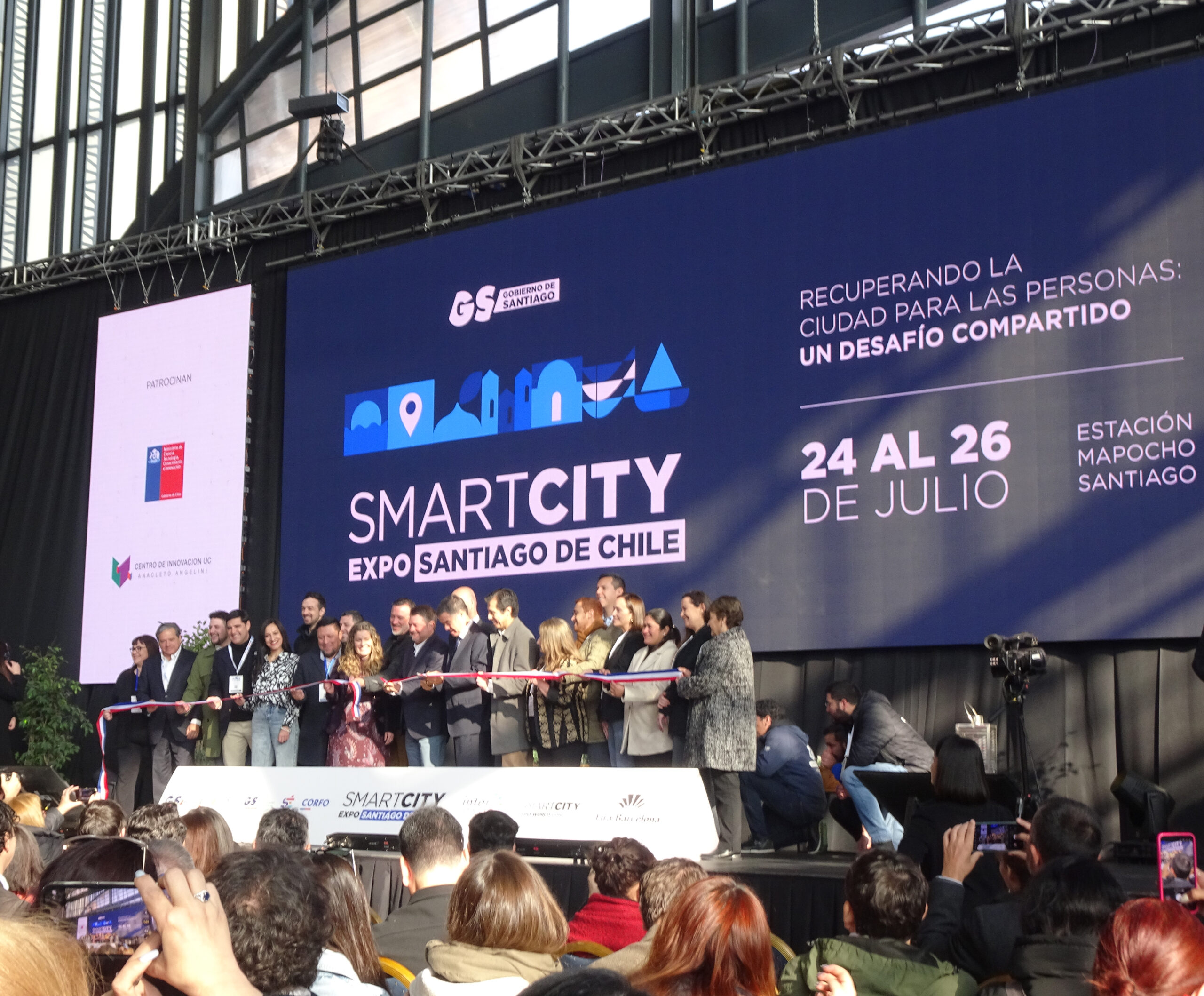
At the recent Smart City Expo in Santiago, Chile, Marta Rofin Serra, the founder and CEO of Healthy Cities, discussed ways to design urban environments that promote healthier lifestyles. According to the evidence suggesting that nearly 90% of our health is influenced by factors beyond the healthcare system, she demonstrated how the design of mobility, public spaces, and housing has a direct impact on our physical activity, breathing, rest, and social connections. Our urban surroundings have a profound impact on our overall well-being, influencing our physical, mental, social, and environmental health.
Living far from city centers can accelerate aging disparities, since those on the periphery often face delayed access to healthcare, healthy food, cultural activities, and safe transportation. Cities should be designed as health-promoting ecosystems, rather than just residential areas, to either reduce or widen health inequalities through urban planning decisions.
Rofin Serra highlighted how urban form directly impacts health and longevity, stressing that people living far from central affluent areas, well-designed neighborhoods where healthcare, mobility, and social services are concentrated, face an “aging gap” compared to those with easy access. She framed cities as tools to actively promote health and equity.
Recent research reinforces these ideas. The Baker Institute argues that cities should be designed as brain‑healthy environments, where infrastructure and public space actively foster cognitive resilience and well‑being. Evidence from ISGlobal (*) in Europe shows that compact, walkable urban forms reduce disease and premature mortality, while car‑centered sprawl worsens pollution and inequities, highlighting the need for nature‑based solutions to restore health and sustainability. Complementing these findings, Frontiers’ concept of the “extended mind” in public space emphasizes how plazas, parks, and meeting places act as extensions of human cognition and emotion, shaping social interactions and well‑being.
Santiago’s Peripheral Communes
Although the aging gap is recognized as a global concept, targeted studies can be undertaken in Latin American cities, where the dynamics of urban sprawl in large metropolitan areas expose structural inequities and shortcomings in planning.
Recent studies on Santiago and the Metropolitan Region have shown that urban health inequities manifest in clear gradients of mortality and Potential Years of Life Lost (PYLL). During the COVID-19 pandemic, low-income municipalities experienced disproportionate increases in mortality and PYLL. Although rates declined in the post-pandemic period, inequities resumed their upward trajectory, demonstrating that longevity is intrinsically tied to effective proximity to services, opportunities, and community networks.
In our research “Proximity and the 15-Minute Concept”, a comparative study of two communes in Santiago and the Metropolitan Region, we go deep into the disparities between the central and the peripheral sprawls of the city. Santiago’s rapid suburban growth has produced a fragmented metropolis where starkly divided communities coexist within a complex urban fabric. Spatial disconnection reinforces economic disparities, shaping accessibility, mobility, and cohesion across the city.
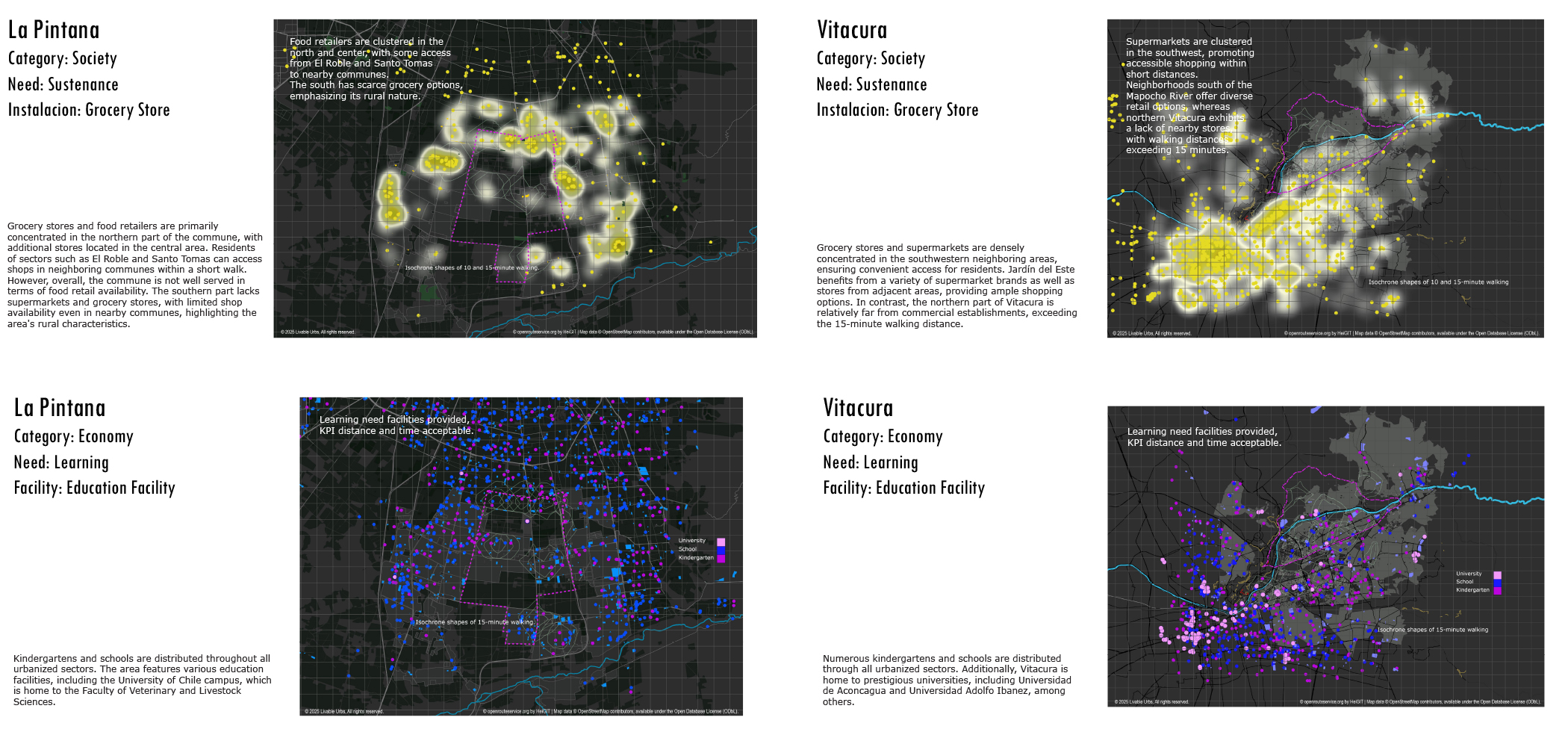
Proximity study in Santiago and the Metropolitan Region, Chile (LivableUrbs)
Vitacura stands out for its privileged location within Santiago. South of the Mapocho River, it concentrates dense, well‑connected urban development, while the northern area is defined by high‑end residential neighborhoods with abundant green spaces. Its immediate proximity to the city’s main commercial and financial hubs allows residents to reach offices, services, and business centers within minutes, on foot, by car, or via public transport. With direct access to major roads and an efficient network of buses and metro lines, travel to key employment districts is fast and convenient. This combination of connectivity, exclusive surroundings, and closeness to opportunities makes Vitacura one of the most advantageous areas for professionals.
Southern communes such as La Pintana embody Santiago’s stark socioeconomic contrasts, shaped by their distance from the city center and persistent infrastructure limitations. La Pintana offers a range of workplaces, from offices and industries to retail shops, with commute times varying significantly depending on the destination. While some local businesses and commercial areas are within a 15-minute walk, most job opportunities are in central Santiago or other key districts, requiring longer commutes. Typically, it takes 30-45 minutes to reach major hubs like Providencia or Las Condes by car, depending on traffic, while using public transport to central Santiago usually takes 40-60 minutes with bus and metro connections. Many workplaces are located far from commercial areas, making it hard to walk to them quickly.
Lengthy commutes and disjointed transport systems have a negative effect on mental health, the environment, and overall well-being. The reliance on cars is attributed to a combination of factors, including limited local access, weak connectivity, outdated infrastructure, and inadequate public initiatives. To achieve healthier and more sustainable urban living, it is essential to have efficient, accessible, and intermodal networks that prioritize planning based on proximity.
Implications for Public Policy and Future Perspectives
Ongoing debates surrounding territorial justice and livability in Latin American cities focus on the issue of peripheral growth, which frequently results in underserved communities. The Livability Equity Map shows how urban indicators, including mobility, housing, environment, and social infrastructure, are interconnected and influence health and opportunity. By conceptualizing time and distance as essential yet invisible factors in livability, we can identify where equity is established and where it falls short, ultimately informing cities’ pursuit of more just and resilient futures.
It is imperative that cities are designed as ecosystems that promote health. To achieve this, we need frameworks that prioritize resilience, spatial equity, and collaborative governance in an inclusive manner. Metropolitan agendas should be shaped by local data and community involvement, ensuring they are flexible, fair, and sensitive to the diverse needs of different areas.
Conclusion
The concept of a 15-minute city, as explored through proximity research in Santiago, provides a new perspective to address these inequities. Urban health should be a fundamental right, accessible to every neighborhood, not just a privilege reserved for central districts. Proximity by itself is not sufficient. True equity can only be achieved by examining interconnected indicators, like those in the Livability Equity Map, which reveal how housing, mobility, environment, and social infrastructure intersect and influence health outcomes. By adopting a human-centered approach, we can gain a more empathetic and actionable understanding of urban spaces.
The findings in La Pintana highlight the need for targeted interventions and strengthened capacities to address systemic shortcomings, while the more affluent areas of Vitacura reveal subtler disparities, particularly regarding active transportation and reducing car dependence in their northern sectors. These differences underscore the urgency of designing strategies that respond to shifting contexts and evolving community priorities, and they point to a broader principle: healthy cities are not defined solely by healthcare facilities or green spaces, but by the everyday geographies of time and distance that shape how we live. The urban health gradient shows that longevity is closely tied to effective proximity to opportunities, services, and community networks.
Ultimately, the challenge for planners and policymakers is to rethink city-making through inclusive frameworks that prioritize resilience, spatial equity, and collaborative governance. Grounded in localized data and participatory processes, the recommendations point toward a metropolitan development agenda that is adaptive, just, and responsive to diverse realities. If the place where we live can determine how long we live, then the future of public health lies in reimagining urban form, designing cities where proximity is not a privilege but a right, and where livability and longevity are inseparable from justice.
(*) ISGlobal, Barcelona Institute for Global Health. New Index Ranks 917 European Cities on Urban Design for Health and Well-Being.
Additional readings and references that support this article.
Marta Rofin, Reimaging Smart Cities through the Lens of Health: Martin Rofin at Smart City Expo Santiago, July 2025.
Baker Institute, Brain-Healthy Cities: How Urban Planning Can Foster Healthy Brains and Minds, (2024).
IS Global, Barcelona Institute for Global Health, New Index Ranks 917 European Cities on Urban Design for Health and Well-Being, (2025).
Gruosso, S.; Del Signore, M.; Di Cinsio, A.; The extended mind of public space: how urban design shapes human experience, Frontiers, (2025).
Avala, A.; Vargas, C.; Elorrieta, F.; Inequity in mortality rates and potential years of life lost caused by COVID-19 in the Greater Santiago, Chile, Nature, Scientific Report (2023)